What a Kid's Button Business Costs, and What It Could Make
A worksheet walk-through of a family button business: parts, a press, a $2 price, and how many buttons it takes to pay for the machine. Estimates, not results.
BiteSizeLaunch team4 min read


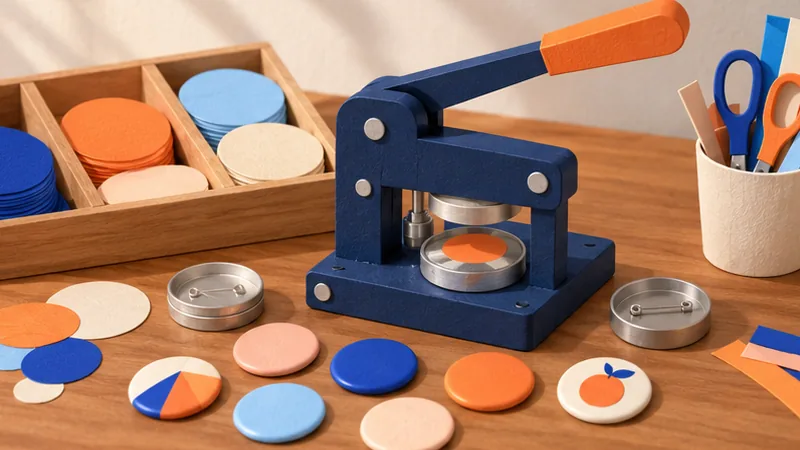
You can work out whether a button business pays before you buy a press.
The numbers below come from our own Buttonology pricing worksheet. They are worksheet estimates. We are not reporting what any table sold, and we are not promising what yours will.
The five numbers
Price. $2 for one button, or $5 for three. These are the prices our family used at its first fair table.
Parts. A shell, a pin back and a clear cover run about 4 to 8 cents. The paper insert adds 2 to 5 cents. That makes 6 to 13 cents a button. Our pricing notes give a rough illustrative figure of 10 to 15 cents, which is not a measured cost. We use 15 cents below.
The press. Our worksheet uses $120. Press prices vary a lot, so swap in the real price of the one you are looking at.
Time. The worksheet leaves a line for the minutes it takes to make each button. At its starting number, three minutes adds about 10 cents. That is a low hourly rate, so raise it if you want the business to pay for your time. With that line included, the worksheet's sample total is 19 cents a button: 6 cents for parts, 3 cents for paper and 10 cents for time.
Booth fee. Many fairs charge one. We use $50 as a made-up example. Check what your events actually charge.
How many buttons pay for the press
The U.S. Small Business Administration has a free pricing worksheet with a breakeven formula: fixed costs per month divided by price per unit minus variable cost per unit. We use the same division for a one-time cost. The press is the cost to recover, and parts are the variable cost.
Each $2 button leaves $1.85 after parts. $120 divided by $1.85 is 64.9, so about 65 buttons.
- Count your time at the worksheet's 19 cents, and it takes 67 buttons.
- Sell every button in the three-for-$5 deal, and each one brings in $1.67 and leaves $1.52 after parts. That takes 80 buttons. A bundle can sell more buttons, but it stretches the payback.
- Pay a $50 booth fee, and the first 28 buttons only cover the table. The press and the table together take 92 buttons.
What it could make
Here is the same math at three volumes. It leaves out booth fees and your time, and it is an estimate.
| Buttons sold at $2 | Money in | Parts at 15 cents | Left before the press | After a $120 press |
|---|---|---|---|---|
| 30 | $60 | $4.50 | $55.50 | $64.50 short |
| 65 | $130 | $9.75 | $120.25 | break even |
| 100 | $200 | $15.00 | $185.00 | about $65 ahead |
Those rows are arithmetic. They are not sales. We do not have a verified count of how many buttons a table sells in a day, so we will not guess one.
A button business runs in bursts. In our method, the week of an event is full of work, and most weeks without an event have little or none. We think the number of events you can get into matters more than the price you pick.
Who runs the press
The press takes real force. In our method, an adult runs the press and handles the money. The child designs, cuts, loads the parts and talks with customers.
That affects the money. An adult's calendar is part of what the business costs. We treat that as a risk: if the adult's calendar is full, the business does not run.
Before you buy anything
Plan your first sale and your next three months of events before you spend $100 or more. Find two events. Ask each organizer what a table costs and what kind of buyers come. Then run your own numbers with the formula above.
If the numbers only work at a volume you cannot see yourself reaching, a button business may not be the right first business.
Money and taxes
Keep the cash with a parent and save every receipt for supplies. If sales become regular, ask a tax professional what to report. We cannot give tax or legal advice here.
Where BiteSizeLaunch fits
The Buttonology blueprint includes a price planner where you fill in your own costs, time and price for an order, and an event plan that works out how many sales cover a table fee. It is a digital guide. It does not include a press or supplies, and the supply list shows what a setup costs today.
If your family wants to try an idea first, the free guide, BiteSize Classics, is an illustrated story your family reads together. The quiz can help you pick a business.
Share this article